
20 Best Decibel Meters for 2026
Kicking off our 2026 ranking, one decibel meter survived a demolition site plunge—but which one earned our top spot?


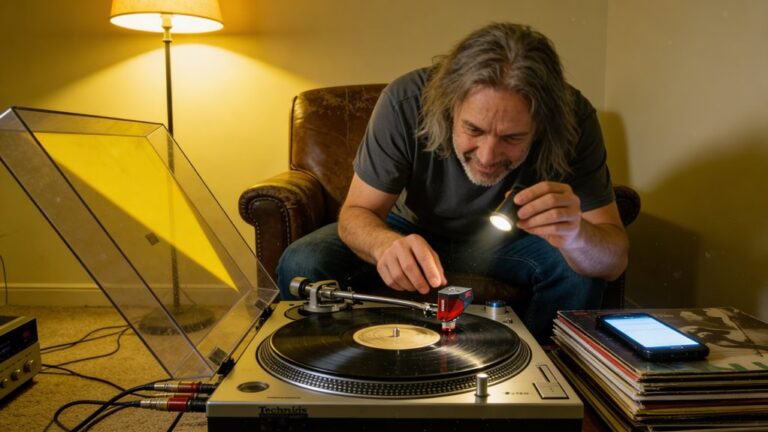

The hunt that never really ends.
Vinyl should have been killed by the CD in 1983. Then by MP3 in 1999. Then by streaming in 2010. It survived all three because a record player in a room playing music is a fundamentally different experience from a file being decoded by an algorithm and pushed through a phone speaker.
The groove is physical. The needle is physical. The dig is physical. VinylFlipper exists for people who understand why that matters — and for people who are starting to suspect it might.
Before there was a flip, there was a needle. The phono pickup is one of the most quietly revolutionary inventions in audio history. Click any era to read the story.
Thomas Edison’s phonograph used a crude steel stylus to scratch vibrations directly into tinfoil wrapped around a hand-cranked cylinder. It could play back only a minute or two before the foil tore. The needle was effectively disposable — changed after every single play. There was no cartridge, no electronics, no amplification: the groove vibrated the stylus, which vibrated a diaphragm, which pushed air. The whole machine was acoustic, mechanical, and extraordinarily fragile. Sound quality barely deserved the word.
Emile Berliner’s gramophone moved reproduction from cylinders to flat shellac discs — the direct ancestor of every record ever pressed. Steel needles were still standard, but listeners quickly discovered that bamboo tips or cactus spines were softer on the groove. Changing the needle between plays was considered normal practice. The disc format also made duplication practical for the first time: one master pressing, thousands of copies, and suddenly a real commercial market for recorded music existed.
The first commercially successful electrical phonograph pickup arrived in 1925, adapted from early loudspeaker research. Instead of relying purely on acoustic vibration, the stylus now moved a coil through a magnetic field — generating a tiny electrical current that could be amplified and sent to a speaker. Sound quality leapt forward overnight. The records themselves still used shellac and the grooves were comparatively crude, but the era of purely mechanical playback was definitively ending.
Crystal and ceramic pickups replaced bulky magnetic assemblies with piezoelectric elements — materials that produce voltage when physically bent. They were cheap, sensitive, and required no external magnet. More importantly, the stylus was now housed in a replaceable cartridge that clipped into the tonearm headshell. The GE Variable Reluctance Cartridge pushed further: a suspended cantilever stylus moving between magnets produced dramatically better tracking, far lower groove wear, and a signal clean enough to reveal real detail in the record for the first time.
Columbia’s 33⅓ RPM LP introduced microgroove records pressed in vinyl instead of shellac — quieter, lighter, longer-playing. The old steel needle was too blunt to track grooves this fine without destroying them. Stylus tip geometry became a science: conical gave way to elliptical, elliptical to Shibata, each profile reaching deeper into the groove wall to unearth more recorded information. Industrial diamond replaced softer materials as the standard tip — hard enough to play thousands of records without measurable wear. The modern stylus was born.
The 45/45 stereo groove standard was agreed in 1957 — a brilliant solution that cut two independent audio channels into the two walls of a single groove at 45-degree angles. The stylus had to track both walls simultaneously and independently. This required a complete rethink of cartridge design: the cantilever assembly now needed to resolve lateral and vertical motion separately, doubling the engineering complexity. Early stereo cartridges were often poor at channel separation, and crosstalk between channels was a persistent problem through the early 1960s. The best modern MCs now achieve over 30dB of separation — something that would have seemed impossible to the engineers who cracked the standard in 1957.
Matsushita released the Technics SL-1200 in 1972, a direct-drive turntable originally aimed at radio broadcasters. It found its true audience a decade later in hip-hop and electronic music, where DJs discovered that direct drive meant instant torque recovery after a scratch. DJ use created an entirely new set of demands on the cartridge: it needed to survive being manually dragged backwards across the groove thousands of times per night. Specialist DJ cartridges like the Shure M44-7 and later the Ortofon Concorde were built for abuse rather than audiophile resolution. The SL-1200 Mk2 remained in production until 2010 and is still the industry benchmark for DJ applications.
Sony and Philips launched the Compact Disc commercially in 1982–83, and for much of the decade the industry declared vinyl dead. Record labels stopped pressing new titles on vinyl. Pressing plants closed. But a counter-movement formed immediately among audiophiles who argued — with some justification — that early CD mastering was harsh, and that a properly set up turntable with a good moving coil cartridge could resolve musical information that 16-bit digital simply couldn’t store. Cartridge manufacturers like Lyra, Koetsu, and van den Hul began producing hand-built moving coil cartridges at prices that would have seemed absurd a decade earlier. The audiophile turntable market quietly boomed throughout the 1990s even as mainstream vinyl retail collapsed.
Around 2007, something shifted. New artists started releasing on vinyl not as a niche audiophile choice but as a primary format. Independent record stores began reporting double-digit year-on-year growth in vinyl sales. Record Store Day launched in 2008 and immediately became a cultural event, with queues forming outside independent stores hours before opening. The shift wasn’t driven by older audiophiles — it was younger listeners, often hearing vinyl for the first time, drawn to the ritual and the physical object. The pressing plant capacity that had been mothballed through the 1990s was suddenly insufficient, creating bottlenecks that still affect production times today.
Vinyl outsold CDs in the United States in 2020 for the first time since 1987. Modern cartridges split into two main camps. The moving magnet (MM) uses a tiny magnet on the cantilever moving between fixed coils — affordable, compatible with most phono stages, and user-replaceable at home. The moving coil (MC) flips the design: fixed magnets, coils wound directly on the cantilever. Less mass moving means more precise tracking, lower distortion, and a more revealing signal — at significantly higher cost. A handful of manufacturers are now experimenting with strain-gauge and optical pickups that generate signal without magnetic induction entirely. The groove is 150 years old. The technology reading it is still evolving.
Every recommendation comes from someone who actually digs through crates, not spec sheets. No manufacturer relationships. No sponsored picks. Just honest opinions from a collector who’s heard the gear.
Prices are checked against real market data before every guide goes live. What you see reflects what records and gear actually sell for — not last year’s inflated MSRP.
Not for audiophiles who collect equipment instead of music. For people who come home with a bag full of records and have to figure out where to put them. One standard, every guide.