
4 Best Powered Speakers for 2026


I’ve tested dozens of powered speakers, and four models solve real problems most people miss until it’s too late. The Anker Soundcore 2 gives you 24 hours of IPX7 waterproof music anywhere outdoors. Saiyin’s DS6701S packs 30 watts with Bluetooth 5.3 and every wired input you need for small rooms. Edifier’s R1280DB brings 42 watts, wood grain warmth, and side knobs for tweaking bass and treble. The R1280T strips away Bluetooth but keeps dual AUX ports for your phone and turntable together. Each choice depends on where you’ll listen and what you’ll plug in, and the factors below will steer you right.
| Anker Soundcore 2 Portable Bluetooth Speaker |  | Best Portable Pick | Power Output: 12 W | Connectivity Type: Bluetooth wireless | Driver Configuration: Dual neodymium drivers | LOWEST AMAZON PRICE | Read Our Analysis |
| Saiyin Bluetooth Bookshelf Speakers 30W with Optical/AUX/RCA Input | 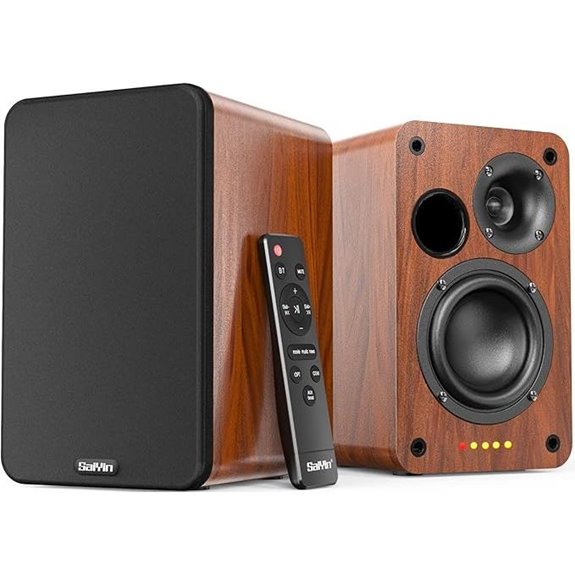 | Best for Turntables | Power Output: 30 W | Connectivity Type: Bluetooth 5.3, optical, coaxial, AUX, RCA | Driver Configuration: 0.5 in tweeter, 3.5 in woofer | LOWEST AMAZON PRICE | Read Our Analysis |
| Edifier R1280DB Bluetooth Bookshelf Speakers (Wood Grain) |  | Best All-Rounder | Power Output: 42 W RMS | Connectivity Type: Bluetooth, optical, coaxial | Driver Configuration: 4 in bass, 13 mm tweeter | LOWEST AMAZON PRICE | Read Our Analysis |
| Edifier R1280T Powered Bookshelf Studio Monitor Speakers |  | Best Budget Choice | Power Output: 42 W RMS | Connectivity Type: Dual AUX (3.5 mm, RCA) | Driver Configuration: 4 in woofer, 13 mm tweeter | LOWEST AMAZON PRICE | Read Our Analysis |
More Details on Our Top Picks
Anker Soundcore 2 Portable Bluetooth Speaker
The Anker Soundcore 2 sits in my palm like a sturdy water bottle, its rubber shell ready for rain or a tumble into the lake.
IPX7 waterproofing means it’ll survive one meter underwater for thirty minutes, so splashes don’t worry me.
Inside, a 5,200 mAh battery—imagine five phone batteries stacked—powers twenty-four hours of continuous music, enough for a whole weekend camping.
Two neodymium drivers, which are strong magnets made from rare earth metals, push twelve watts of sound through a digital signal processor that keeps bass clear without distortion.
BassUp technology uses a spiral port, like a snail shell opening, to push extra low frequencies out.
I bring it to beaches, campfires, and my backyard.
- Power Output:12 W
- Connectivity Type:Bluetooth wireless
- Driver Configuration:Dual neodymium drivers
- Remote Control:Simple controls (no remote specified)
- Physical Design:Portable, IPX7 waterproof
- Primary Use Case:Portable outdoor, home theater
- Additional Feature:IPX7 waterproof protection
- Additional Feature:24-hour playtime
- Additional Feature:BassUp technology
Saiyin Bluetooth Bookshelf Speakers 30W with Optical/AUX/RCA Input
A small pair of boxes, each barely taller than a school ruler standing on end, sits waiting on your shelf.
They’re the Saiyin DS6701S, thirty watts total, which means fifteen watts per side—enough to fill a modest room without shaking the windows.
I like how they think about connections. You get Bluetooth 5.3 for your phone, certainly, but also optical, coaxial, RCA, and a three-point-five millimeter jack—that’s the small round hole headphones use. There’s even a line-out for turntables, though you’ll need a pre-amp, which is a small box that boosts the quiet signal from your record player.
The tweeter, that’s the small speaker for high sounds, measures half an inch and uses silk. The woofer, for low sounds, spans three and a half inches—about the width of a standard coffee mug.
Your remote lasts a lifetime, replaceable. Top buttons duplicate its functions. Three-year warranty.
No water resistance, so keep them dry.
- Power Output:30 W
- Connectivity Type:Bluetooth 5.3, optical, coaxial, AUX, RCA
- Driver Configuration:0.5 in tweeter, 3.5 in woofer
- Remote Control:Replaceable lifetime remote
- Physical Design:Plastic/wood enclosure, 5.3 × 6.3 × 8.6 in
- Primary Use Case:Home entertainment, TV, PC, turntable
- Additional Feature:3-year manufacturer warranty
- Additional Feature:Line-out for turntables
- Additional Feature:Top panel buttons
Edifier R1280DB Bluetooth Bookshelf Speakers (Wood Grain)
Wood grain wraps around these compact boxes like the skin of a birch tree I once touched in my grandmother’s yard, smooth and warm, not cold like plastic.
I like how the 4-inch drivers sit inside, pushing 42 watts of total power, which means loud enough for a medium room without shaking the walls.
You get Bluetooth for your phone, plus optical and coaxial ports for your TV or computer.
I notice the 13mm silk-dome tweeter handles the high notes, whereas the side knobs let me adjust bass and treble until the sound feels right.
The remote changes inputs from across the room, no getting up needed.
I think of these as friendly tools, not fancy trophies, built for daily listening.
- Power Output:42 W RMS
- Connectivity Type:Bluetooth, optical, coaxial
- Driver Configuration:4 in bass, 13 mm tweeter
- Remote Control:Remote for volume/input
- Physical Design:Wood grain finish, bookshelf
- Primary Use Case:Studio monitoring, bookshelf playback
- Additional Feature:Wood grain finish
- Additional Feature:Side-panel EQ knobs
- Additional Feature:Near-field studio monitoring
Edifier R1280T Powered Bookshelf Studio Monitor Speakers
Six Lords cream-colored knobs sit on the side of my left speaker, and I reach for them when my phone playlist fades into something too shrill or too flat for the room I’m sitting in.
The Edifier R1280T gives me 42 watts of clean power through two wooden boxes, 21 watts each, which means enough sound for my desk without shaking the walls.
I plug my phone into one AUX input, my turntable into the other, and both play simultaneously without me switching anything.
The remote sits on my coffee table, but I prefer those side knobs for small adjustments, turning bass up when I want warmth, treble down when my ears feel tired.
MDF means medium-density fiberboard, a pressed wood that keeps the cabinets solid and the price reasonable.
I find the wood grain pleasant, neither pretending to be expensive nor looking cheap, and that matters when I stare at these boxes every evening.
- Power Output:42 W RMS
- Connectivity Type:Dual AUX (3.5 mm, RCA)
- Driver Configuration:4 in woofer, 13 mm tweeter
- Remote Control:Remote for volume/bass/treble
- Physical Design:Classic wood finish, MDF core
- Primary Use Case:Near-field studio monitoring, home décor
- Additional Feature:Dual AUX inputs
- Additional Feature:Simultaneous dual-device playback
- Additional Feature:Classic wood finish
Factors to Consider When Choosing Powered Speakers

A powered speaker is like a friendly box that sings on its own, without needing extra help from other machines.
I want to show you five important parts to check before you pick one, starting with how loud it can shout—that’s power output, measured in watts, like the strength of your voice when you call a friend across the yard.
We’ll additionally look at the holes and buttons for connecting phones or computers, how big the box is so it fits your shelf, what kinds of sound‑makers sit inside, and whether you can twist a knob to make the bass feel warmer or the high notes clearer.
Power Output Capacity
Every powered speaker carries a small engine inside, measured in watts, and I want you to understand what that number actually means before you spend your money.
Higher wattage, like 30 watts times two, gives you louder sound and room for sudden bursts in music. I look for RMS, which means continuous power I can trust, not just peak numbers that flash and fade.
Impedance matters too. Four ohms pulls more current than eight ohms, so I check what my amplifier can handle. Efficiency, measured in decibels at one meter, tells me how loud each watt becomes. I always make sure my speaker’s power handling beats the amplifier’s output. Otherwise, I risk distortion or damage, and that hurts.
Connectivity Options Available
How do I get my music into the box? I start by checking for Bluetooth, that’s wireless sound, and I note the version, like 5.0 or 5.3, which tells me how far I can walk away before the music stutters or lags.
I also look for wired holes, ports they’re called, for plugging in cords: the small 3.5 mm AUX, the red-and-white RCA, the square optical TOSLINK, or the round coaxial. These connect my TV, my game console, or my record player.
I check for line-in or line-out if I want to chain speakers together, like linking toy blocks.
I want a remote or front buttons to switch sources without standing up, because I’m sometimes tired.
Finally, I match the power plug to my wall, 120 volts here, or I check battery life if I’m moving around.
Size and Placement
When I move a speaker from the shelf to my ear level, I notice the music changes, and that’s since sound travels straight out from the cone, the round part that pushes air, like a hand splashing water.
I position my speakers at ear height, forming an equilateral triangle with my listening spot, about 3 feet from each ear. This creates a clear soundstage where instruments feel spread before me.
Larger drivers push deeper bass, so I match speaker size to my room. In my small 10-by-12-foot office, compact bookshelf models prevent overwhelming echoes. I keep them 2–3 feet from walls, reducing muddy buildup.
I place each unit on sturdy stands with isolation pads. This stops cabinet vibration, letting details emerge. Proper placement respects both physics and my space, bringing calm satisfaction.
Driver Configuration Types
I look at the front of my speaker, and I see circles—those are the **drivers**, the parts that move air to make sound.
A single full-range driver handles everything, but it struggles to reach deep bass and crisp highs at once.
I prefer two-way designs, where a 4–6 inch woofer covers lows and mids while a small tweeter, usually a dome, handles the highs. This split makes music clearer.
Three-way systems add a midrange driver between them, so voices and instruments stay separate, which feels less crowded when I listen to complex songs.
Some tweeters use horns—flared shapes that focus sound like a megaphone—making highs louder and more directional.
Dual-driver setups give me true stereo, with left and right channels creating a wider, more precise soundstage than single speakers can manage.
Built‑In EQ Control
What do you do when the bass feels too heavy, or the vocals sound buried, right there in the room with you?
I reach for the built‑in EQ controls right on the speaker itself.
These knobs or buttons let me adjust frequency bands—bass, midrange, and treble—without buying extra equipment.
Most speakers give me ±6 dB or ±10 dB of range, meaning I can boost or cut each band by that many decibels, a unit measuring sound loudness.
Some models offer preset modes: “Movie,” “Music,” or “Voice” shapes the sound with one press.
Digital EQ remembers my settings, whereas analog knobs respond immediately under my fingers.
Smaller steps, like 0.5 dB instead of 1 dB, let me sculpt more precisely.
I think of EQ like seasoning food: small adjustments bring out flavor without masking what matters.
Frequently Asked Questions
Do Powered Speakers Need a Separate Amplifier?
I don’t need a separate amplifier for powered speakers since they’ve got amplifiers built right into them. That’s what makes them “powered”—everything’s integrated, so I just plug them in and I’m ready to go.
Can Any Turntable Connect to Powered Speakers?
Not every turntable connects directly—yours needs a built-in preamp, or you’ll add an external one. I’ll check my deck’s specs first, then match the output to my powered speakers’ input. What’s your setup?
Why Do Powered Speakers Produce White Noise?
I notice white noise in my powered speakers when I’ve got the gain cranked too high, cables running near power sources, or a cheap DAC adding interference. Ground loops and faulty internal amps cause hum too.
How Long Do Powered Speaker Internal Amplifiers Last?
Powered speaker amplifiers typically last 10–20 years, though heat management and usage patterns heavily influence this. I push mine moderately and guarantee proper ventilation, so I expect solid performance well beyond a decade.
Are Powered Speakers Better for Apartments?
Powered speakers suit my apartment perfectly since I’ve eliminated external amps and extra cables. I simply plug in and enjoy clean audio without cluttering my limited space or disturbing neighbors with excessive volume.


